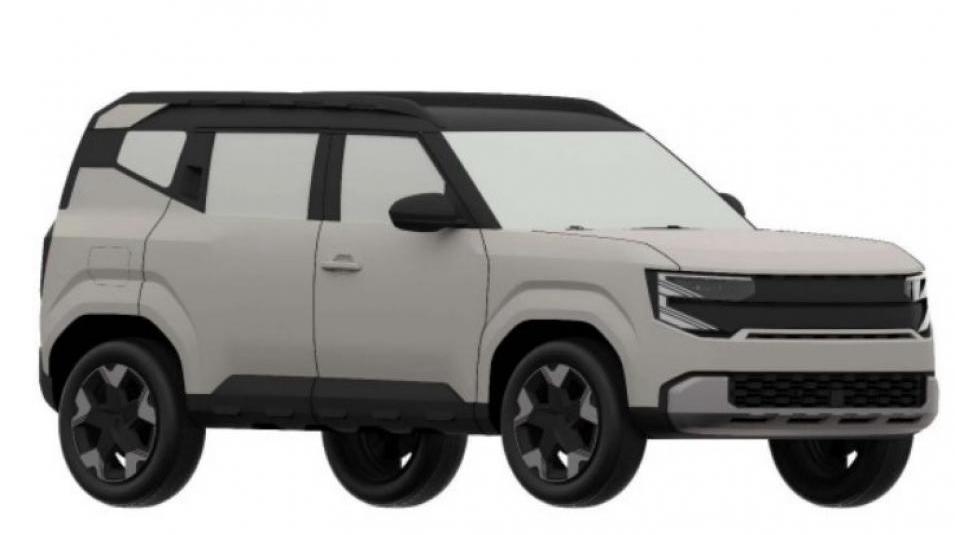
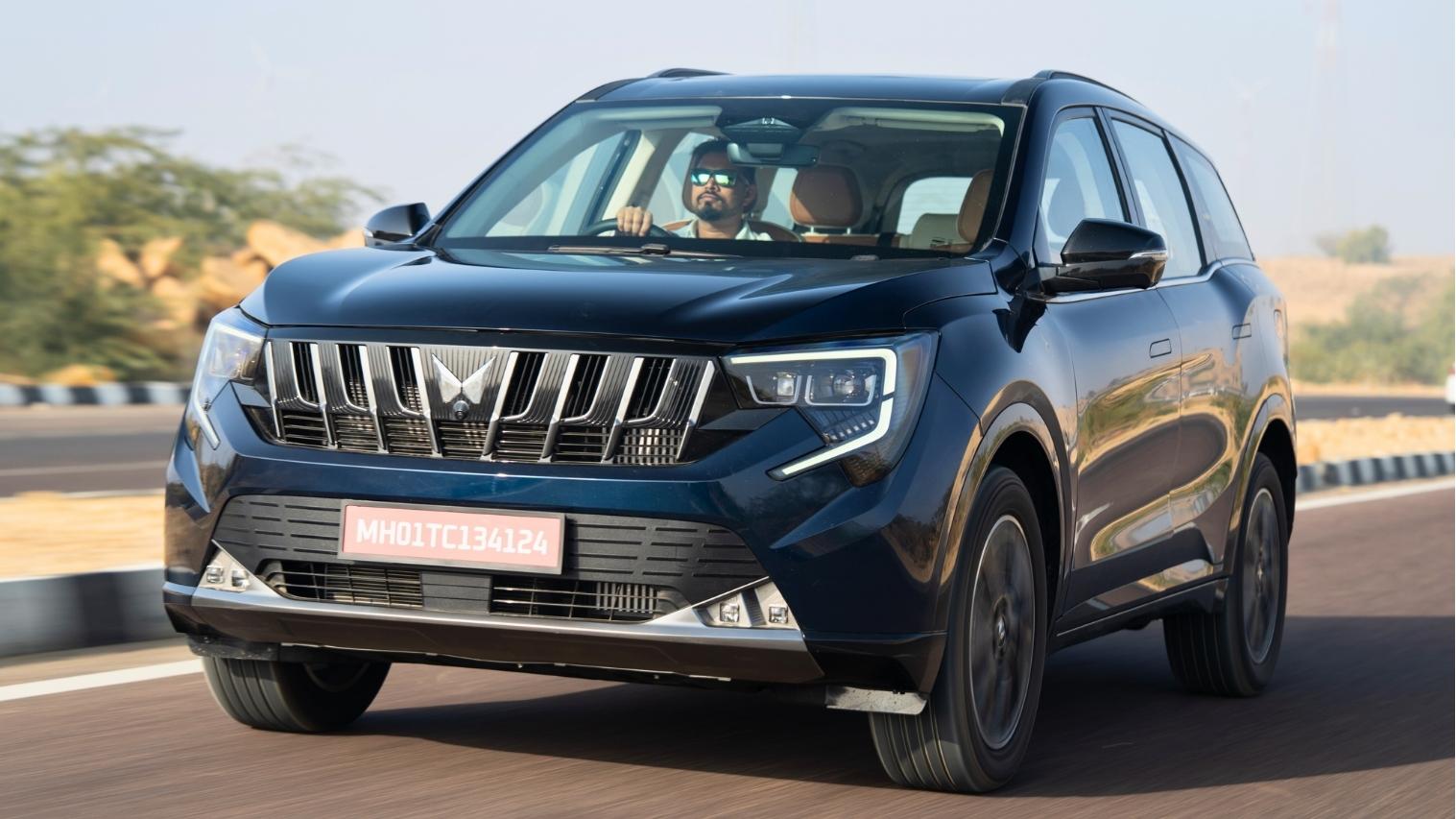
While Renault is basking in the success of the new Duster, the French automaker had earlier announced that they will launch a “mini-Duster” as well which will be a sub-4metre compact SUV. The vehicle will be the new Bridger and it will be positioned below the Duster and along side the Kiger to rival the likes of the Venue, Sonet, XUV 3XO, Syros, Brezza and Nexon. Since it’ll be a more rugged vehicle, it will also rival the Jimny and upcoming Mahindra Vision-S.
A design patent has been filed for the Renault Bridger. As seen from the image, the vehicle has a boxy and upright stance. It has slim headlamps with flared DRLs, a big grille, C-pillar mounted door handles, dual-tone wheels, front bumper garnish, etc. The vehicle is expected to get a tail-mounted spare wheel.
While the exact mechanical specs aren’t known yet, the vehicle is expected to get a 1.3-litre petrol hybrid powertrain and a new 1.2-litre petrol engine. Both manual and automatic options will be offered. There won’t be AWD on offer and the compact SUV will have a FWD configuration.
The Renault Bridger is expected to be launched in India in the second half of 2027.
The PV market will come alive in the month of June 2026 as multiple new car launches have been planned across different segments in India
In June 2026, the auto market will witness the arrival of as many as eight new car models as brands like Tata, Skoda, Citroen, Mercedes-Benz, Honda, BMW, Mini and BYD are expected to bring in offerings across different categories and price brackets.
1. Tata Sierra EV
The Sierra EV will be among Tata Motors’ most important launches this year and is expected to arrive with 65 kWh and 75 kWh battery pack options borrowed from the Harrier EV. Single-motor rear-wheel-drive and dual-motor all-wheel-drive variants are likely to be offered with the larger battery expected to deliver a real-world driving range of over 500 km. The production-spec model will feature a triple-screen dashboard layout, panoramic sunroof, V2L and V2V charging functions, Level 2 ADAS and connected technologies. Prices are expected to start from around Rs. 18 lakh (ex-showroom).
2. Skoda Kodiaq RS
Skoda is expected to introduce the performance-oriented Kodiaq RS as the flagship version. Power will come from a 2.0-litre four-cylinder TSI turbo petrol engine churning out 265 PS and 400 Nm and it will be coupled with a seven-speed DSG automatic transmission and an all-wheel-drive system. The SUV can sprint from 0 to 100 kmph in just 6.4 seconds and will also feature adaptive suspension, sport seats, larger brakes and RS-specific styling elements. Pricing is expected to exceed Rs. 55 lakh (ex-showroom).
3. Citroen eC3 X
The Citroen eC3 X will likely utilise the same 29.2 kWh battery pack and front axle mounted electric motor producing 57 PS and 143 Nm as the existing eC3. A claimed driving range of around 320 km is expected as before as the major difference will be the addition of new features and technologies.
4. Mercedes-Benz S-Class Facelift
Mercedes-Benz is preparing to introduce the updated S-Class with subtle exterior revisions and improved tech by the middle of the month. Changes are expected to include revised LED headlamps, updated grille detailing and the latest MBUX software suite. The luxury sedan will continue with six-cylinder petrol and diesel powertrains alongside mild-hybrid technology. It will also get new comfort functions, rear-seat enhancements and upgraded driver assistance systems. Prices could begin from around Rs. 1.90 crore (ex-showroom).
5. Honda ZR-V
Alongside launching the City facelift a few weeks ago, Honda unveiled the ZR-V hybrid for India and commenced its official pre-bookings. Positioned as a premium midsize SUV above the Elevate, it will be brought into the country via CBU route and its prices could be revealed this month. The SUV will be available with Honda’s strong hybrid e:HEV system combining a 2.0-litre petrol engine with twin electric motors. Combined output stands at around 184 hp while fuel efficiency exceeds 20 kmpl in several markets.
6. BMW X6 Facelift
The facelifted BMW X6 will arrive with updated styling, revised lighting signatures and BMW’s latest curved display interface. Globally, the SUV is offered with 3.0-litre six-cylinder petrol and diesel engines featuring 48V mild-hybrid assistance. Outputs range from around 298 hp to over 380 hp depending on the variant. The updated X6 will continue to feature xDrive all-wheel drive, adaptive suspension and a coupe SUV profile. Prices are expected to start above Rs. 1.45 crore (ex-showroom).
7. New Mini Countryman C
The Mini Countryman C has grown significantly compared to its predecessor and now measures around 4.44 metres in length and it will be launched on June 17. Power is derived from a 136 hp 1.5-litre three-cylinder turbo petrol engine mated to a seven-speed dual-clutch automatic transmission as in the BMW X1. The crossover also receives a 240 mm circular OLED touchscreen, Level 2 driver assistance features and a more spacious cabin.
8. New BYD PHEV
BYD has already confirmed that its first plug-in hybrid model for India will debut soon with the Atto 2 DM-i and Sealion 6 emerging as the strongest contenders following the release of a teaser. The Atto 2 DM-i uses a 1.5-litre naturally aspirated petrol engine paired with either a 7.8 kWh or 18 kWh battery pack and offers a combined driving range of up to 998 km. If BYD chooses the larger Sealion 6, customers could get a 1.5-litre hybrid setup producing up to 218 hp and an electric-only range of up to 140 km.
Bajaj adventure bike is expected to launch sometime next year in India and it could be positioned in the 250-350 cc segment
For years, Bajaj Auto has played a major role in the adventure motorcycle space without actually having a product of its own. The company manufactures KTM’s Adventure series models in India and has access to multiple platforms capable of supporting an Adv. New spy images now suggest that situation could finally be about to change.
A heavily camouflaged test motorcycle has been spotted near Pune and, interestingly, it was not being tested in isolation. The prototype was seen running alongside KTM’s Adventure models and several Pulsars – hinting that the project could be in an advanced stage of development. More importantly, the motorcycle appears substantially different from anything currently sold under the Bajaj badge.
Rather than beginning with engine speculation, the overall package deserves attention first. The test mule carries a tall stance, a pronounced front beak, a long travel suspension setup and what appears to be a 21-inch front wheel. These are not styling accessories added for visual effect as they point towards a motorcycle developed with genuine off-road intentions.
Image Source: on2wee/Instagram
The touring credentials are equally evident. A large rear top box was mounted on the prototype while the long single-piece seat still appeared capable of accommodating a pillion comfortably. The riding triangle also looks upright and relaxed confirming that long distance usability could be a major part of the motorcycle’s character.
Interestingly, a few visible components seem familiar. The swingarm and tail section bear a resemblance to parts seen on the Pulsar NS200 and even the twin vertical tail lamps as in the Pulsar series. If Bajaj is indeed sharing select hardware across platforms, it could help the company achieve one of its biggest strengths – aggressive pricing.
Image Source: on2wee/Instagram
The biggest unanswered question revolves around the engine. One possibility is a version of the Pulsar N250 powertrain. Such an approach would position the motorcycle directly against the Hero Xpulse 210, Suzuki V-Strom SX 250 and Yezdi Adventure. However, the proportions and positioning of the test mule have also triggered speculation about a KTM-derived engine.
If Bajaj chooses the latter route, the motorcycle would move into a higher performance bracket occupied by products such as the TVS Apache RTX 300, Royal Enfield Scram 440 and future Himalayan derivatives as a 350 cc unit could be utilised. The bodywork, proportions and overall execution look much closer to a production-ready machine than an early engineering prototype – raising the possibility of a launch before the end of 2026 but an early 2027 arrival remains equally plausible.
Bajaj already has a strong presence in commuter motorcycles, sporty street bikes and premium segments through KTM and Triumph. Adventure motorcycles remain one of the few areas where the company lacks a direct presence under its own brand and the forthcoming model could change it.
Maruti Suzuki sold a total of 2,42,688 vehicles in May 2026, registering a 35% year-on-year growth (May 2025: 1,80,77 units)
Maruti Suzuki, India’s largest carmaker by sales volume, has set a new monthly sales record, backed by strong growth across vehicle segments. The company sold a total of 2,42,688 vehicles in May 2026, registering a 35% year-on-year growth (May 2025: 1,80,77 units).
The GST revision in September last year and the rising fuel prices owing to tensions in the Middle East appear to be working in Maruti Suzuki’s favour. In May 2026, the company sold 16,275 units of two of its smallest and most affordable cars combined in India – Alto and S-Presso. Compared to the same month in 2025, the company witnessed a whopping 140% growth in this so-called “Mini” segment (May 2025: 61,960 units).
Higher up in the compact and mid-size car segments, in which Maruti Suzuki offers the Baleno, Celerio, Ciaz, Dzire, Ignis, Swift, and WagonR, the company recorded 81,555 units in sales last month. Compared to 61,960 units delivered in the same month last year, this marked a growth of 32%.
Brezza, Ertiga, e Vitara, Fronx, Grand Vitara, Invicto, Jimny, Victoris, XL6
79,267
54,889
Vans
Eeco
13,240
12,327
Light Commercial Vehicles (LCV)
Super Carry
3,198
2,728
Sales to other OEM
7,239
10,168
Total Domestic Sales
2,00,774
1,48,858
Total Export Sales
41,914
31,219
Total Sales
2,42,688
1,80,077
In the utility vehicle segment, comprising the Brezza, Ertiga, e Vitara, Fronx, Grand Vitara, Invicto, Jimny, Victoris, and XL6, Maruti Suzuki shipped 79,267 units in May 2026. Compared to 54,889 units sold in May 2025, this marked a 44% growth.
In the van segment, the Eeco is Maruti Suzuki’s only product. It contributed 13,240 units to the company’s domestic sales last month, registering a modest 7% year-on-year growth (May 2025: 12,327 units). Similarly, in the LCV segment, Maruti Suzuki offers only one model – Super Carry, which logged 3,198 units in sales last month, up 17% year-on-year (May 2025: 2,728 units).
Maruti Suzuki also manufactures the Urban Cruiser Hyryder, Urban Cruiser Taisor, Rumion, Glanza, and Urban Cruiser Ebella for Toyota Kirloskar Motor. The company sold 7,239 units of cross-badged models last month, down 29% year-on-year. In total, Maruti Suzuki’s domestic vehicle sales in May 2026 stood at 200,774 units, up 35% year-on-year (May 2025: 148,858 units). The company saw a strong uptick in export shipments as well, with the monthly volume reaching 41,914 units, marking a 34% year-on-year growth (May 2025: 10,695 units).
Kia dispatched 27,586 units during May 2026 reporting a notable increase over both the previous month and the same period last year
Kia India has achieved its highest ever sales performance for the month of May since entering the domestic market continuing the healthy run seen across its SUV and MPV portfolio. The company dispatched 27,586 units during May 2026 reporting a notable increase over both the previous month and the same period last year.
The latest result shows a gain of 5,271 units compared to May 2025 when Kia sold 22,315 vehicles. On a year on year basis, sales improved by 23.62 per cent making it one of the best monthly performances for the brand in recent times. The growth was not limited to annual comparisons either as Kia also posted a marginal month on month increase of 1.10 per cent over the 27,286 units recorded in April 2026.
While established products such as Seltos, Sonet and Carens continue to contribute significantly to volumes, recent launches are beginning to play a role as well. Kia noted that the MY26 Syros has received encouraging customer response following the introduction of a revised variant structure and improved accessibility to automatic transmission options.
As competition intensifies across compact and midsize SUV segments, variant optimisation has become an increasingly important tool for manufacturers looking to drive showroom conversions. Another important contributor is the recently introduced Carens Clavis. Kia says customer response towards the Clavis has been positive while interest has also been building around the Clavis EV.
The positive momentum is equally visible in the year to date figures. Between January and May 2026, Kia India recorded sales of 1,39,197 units compared to 1,21,514 units during the corresponding period last year. The increase of 17,683 units confirms a growth of 14.55 per cent. The Korean auto major appears to be developing multiple new products for India and a compact electric SUV based on Syros could be one of them.
In addition, the hybrid version of the Seltos and more premium SUVs including Sorento hybrid have been rumoured for India. It will be interesting to see how the future product portfolio shapes up.
Mahindra closed the month of May 2026 with total automotive sales of 99,636 units – registering a 20 per cent increase compared to the same month last year
Supply constraints may still be limiting volumes at some suppliers but demand for Mahindra & Mahindra’s utility vehicles continues to show little sign of slowing down across different segments. The company closed the month of May 2026 with total automotive sales of 99,636 units – registering a 20 per cent increase compared to the same month last year.
Mahindra sold 58,021 utility vehicles in the domestic market during May – up 11 per cent from 52,431 units recorded in the corresponding period of 2025. Including exports, total utility vehicle volumes stood at 59,573 units. The tally ensures continued popularity of Mahindra’s SUV portfolio comprising products such as Scorpio N, Scorpio Classic, Thar, Thar Roxx, XUV700, XUV 3XO and Bolero range.
The born electric lineup composing the BE 6, XEV 9e and XEV 9S has also been well received by consumers. The brand’s utility vehicle sales also crossed 1.14 lakh units during the first two months of FY27 with a 9 per cent increase over the same period last year. The domestic commercial vehicle sales reached 24,079 units in May 2026 compared to 20,298 units a year ago with a 19 per cent increase.
Its growth was supported by both small and intermediate commercial vehicle categories. The highest percentage growth came from the three wheeler business. Mahindra sold 12,536 three wheelers in May – nearly doubling volumes from 6,635 units recorded in May 2025 with a 89 per cent increase on a YoY basis.
Exports also moved in the right direction. Overseas shipments increased 37 per cent to 5,000 units compared to 3,646 units during the same month last year. Combined with local volumes, this helped push overall vehicle sales close to the one lakh unit mark. The April-May FY27 period shows a similar trend. The utility vehicle sales reached 1,14,352 units while commercial vehicle volumes crossed 47,500 units.
The three wheeler sales surged 85 per cent to 22,435 units and exports rose 42 per cent to 9,970 units. A closer look at the commercial vehicle business shows continued popularity in the entry level segment. The LCV sales below two tonnes increased 35 per cent to 3,490 units in May while the 2 tonne to 3.5 tonne category recorded a 16 per cent improvement at 20,589 units.
With refreshed versions of existing products and several new ICE and electric SUVs planned over the next few years, the company enters the remainder of FY27 on a positive note across passenger vehicles, commercial vehicles and three wheeler categories.
Bajaj Auto’s exports continue to power growth as May 2026 volumes have risen by 20 per cent
More than 2.13 lakh vehicles shipped overseas in a single month helped Bajaj Auto post another telling performance in the month of May 2026. While domestic demand remained healthy across both two wheelers and commercial vehicles, exports once again emerged as the biggest contributor to the growth of the Chakan-based manufacturer.
Its total sales climbed to 4,61,257 units in May 2026 compared to 3,84,621 units during the same month last year with a 20 per cent increase. Export volumes rose at a much faster pace than domestic dispatches. As has been the case, the major contribution came from the two wheeler business conducted locally and abroad.
Combined domestic and export sales reached 3,93,204 units last month against 3,32,370 units in May 2025 resulting in an 18 per cent increase. The domestic two wheeler sales alone stood at 2,09,528 units – up 9 per cent from 1,91,412 units recorded a year earlier. Exports recorded a much larger gain as overseas two wheeler shipments increased 30 per cent to 1,83,676 units compared to 1,40,958 units during May 2025.
Category
May 2026
May 2025
Growth
2W Domestic
2,09,528
1,91,412
9%
2W Exports
1,83,676
1,40,958
30%
2W Total
3,93,204
3,32,370
18%
CV Domestic
38,503
34,321
12%
CV Exports
29,550
17,930
65%
CV Total
68,053
52,251
30%
Total Domestic
2,48,031
2,25,733
10%
Total Exports
2,13,226
1,58,888
34%
Grand Total
4,61,257
3,84,621
20%
The numbers accounted for nearly half of Bajaj Auto’s total two wheeler volumes during the month. Its commercial vehicles delivered an even better growth rate. Combined sales rose 30 per cent to 68,053 units from 52,251 units in the corresponding period last year. The local CV dispatches improved 12 per cent to 38,503 units.
It must be noted that exports surged 65 per cent to 29,550 units. The figures remains similar when the first two months of FY27 are examined. Between April and May 2026, Bajaj Auto recorded total sales of 9,75,049 units compared to 7,50,431 units during the same period last year with a 30 per cent increase.
Two wheeler volumes reached 8,33,157 units during the period. Meanwhile, domestic sales improved 10 per cent to 4,19,591 units while exports jumped 53 per cent to 4,13,566 units as the gap between domestic and export volumes has narrowed considerably. The commercial vehicles posted the fastest growth within the portfolio.
The total volumes increased 42 per cent to 1,41,892 units from 1,00,124 units and local sales stood at 76,650 units, up 16 per cent while exports nearly doubled to 65,242 units from 33,803 units recorded during April to May 2025. The total exports across two wheelers and commercial vehicles climbed 57 per cent during the first two months of FY27 – compared to an 11 per cent increase in domestic volumes.