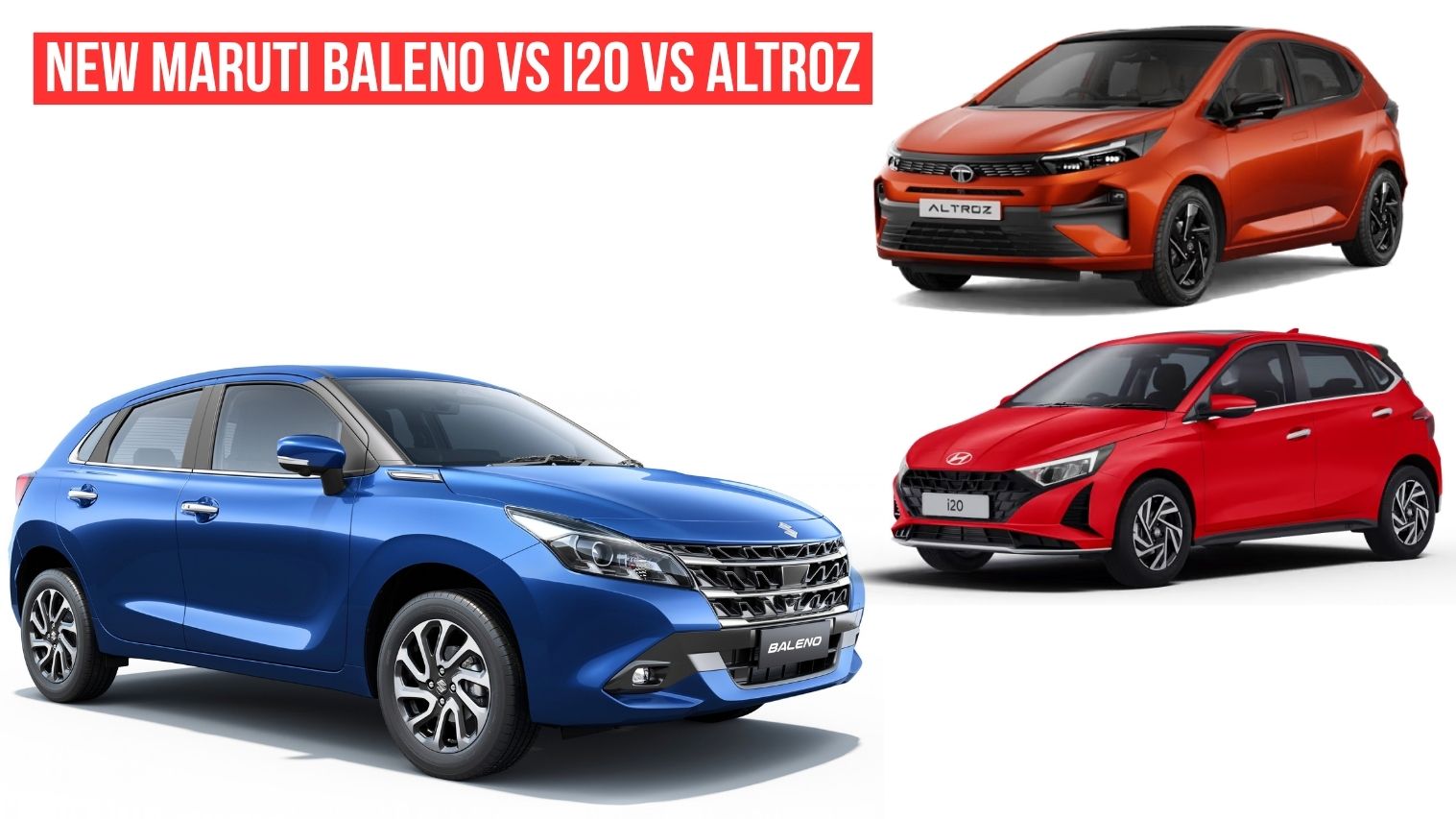
New Maruti Baleno vs Hyundai i20 vs Tata Altroz: Which One To Choose?

GaadiWaadi -

New Maruti Baleno vs i20 vs Altroz

The new Baleno gets a major technology boost, but the i20 and Altroz still have their own strengths in this closely fought segment

Maruti Suzuki has just updated the Baleno, giving its popular premium hatchback a new engine, more features and Level 2 ADAS. Starting at around Rs 6.10 lakh, it now faces the Hyundai i20 and Tata Altroz in a segment where buyers are looking for a mix of efficiency, space, features and safety.

Specification

Maruti Baleno

Hyundai i20

Tata Altroz

Engine

1.2L, 3-cyl petrol

1.2L, 4-cyl petrol

1.2L, 3-cyl petrol

Power

82 bhp

82 bhp

87 bhp

Torque

112.4 Nm

114.7 Nm

115 Nm

Automatic

AMT

IVT

AMT/DCT

Claimed mileage*

23.8 kmpl

~19–20 kmpl

~19–24 kmpl

Boot space

318 litres

311 litres

345 litres

Length

3,990mm

3,995mm

3,990mm

*Varies by variant and transmission

The Baleno has the strongest efficiency argument of the three. Its new 1.2-litre Z-Series petrol engine produces 82 bhp and 112.4 Nm, while the car continues to offer a factory CNG option. The facelift also brings a more comprehensive feature list, including Level 2 ADAS, ventilated front seats and a 360-degree camera.

New Maruti Baleno (3)
New Maruti Baleno

The i20, meanwhile, remains the more premium-feeling option. Its 1.2-litre four-cylinder petrol engine makes similar power but has a smoother character, while the IVT automatic is arguably better suited to relaxed city driving than an AMT. It also has the longest wheelbase of the three at 2,580 mm, which helps cabin space.

Then there is the Tata Altroz, which takes the safety route. Its 1.2-litre petrol engine makes 87 bhp and 115 Nm, and the hatchback offers both AMT and DCT automatic options. It also has the largest boot here at 345 litres. The Altroz is available with petrol and CNG powertrains, making it one of the more versatile choices in this group.

Altroz-iCNG-AMT.jpg
Tata Altroz

The differences become even clearer when you look at how these cars are likely to be used. The Baleno is the most rational all-rounder, particularly for buyers who cover high annual mileage and want low running costs. Its new Z-Series engine, CNG option and claimed 23.8 kmpl petrol efficiency give it a strong practical advantage.

The i20, on the other hand, makes more sense for someone who places greater importance on cabin feel, refinement and a smoother automatic, while the Altroz has the edge for buyers who want the widest powertrain choice and a larger boot.

Hyundai i20 (6)
Hyundai i20

There is also a clear difference in the way each manufacturer has approached the premium hatchback formula. Maruti has gone heavily after technology and efficiency with the new Baleno, including Level 2 ADAS and ventilated seats.

New Maruti Baleno (4)

Hyundai continues to focus on a more premium cabin experience and the convenience of its IVT, while Tata’s Altroz combines a spacious boot with petrol, CNG and diesel choices. That means there isn’t really one universal winner here, the Baleno looks like the strongest value proposition on paper, but the i20 and Altroz still make compelling cases depending on what a buyer values most.

Price
The new Baleno starts at approximately Rs 6.10 lakh, while the i20 and Altroz have broadly similar entry points, depending on the latest variant and pricing structure.

Model

Starting price

Maruti Baleno

Rs. 6.10 lakh

Hyundai i20

Rs. 5.99 lakh

Tata Altroz

Rs. 6.30 lakh

New Maruti Suzuki Baleno 2026 Safety

If mileage and features are your priorities, the new Baleno looks hard to ignore. The i20 makes more sense if refinement and a good automatic are higher on your list, while the Altroz remains the choice for buyers who want a solid, safety-focused package with multiple powertrain options. With the new Baleno raising the feature bar, this three-way battle has suddenly become interesting again.

The post New Maruti Baleno vs Hyundai i20 vs Tata Altroz: Which One To Choose? appeared first on Gaadiwaadi.com - Latest Car & Bike News by Team GaadiWaadi.


from Gaadiwaadi.com – Latest Car & Bike News https://ift.tt/mHGDXl5

Hyundai To Launch 3 New SUVs Soon – Bayon To Electric SUV

GaadiWaadi -

2027-Next-Gen-Hyundai-Creta-Rendered-1.jpg

Hyundai to launch at least three all-new SUVs in the Indian market within a year, including its first-ever hybrid model

Hyundai has not had any major launches in India since the second-gen Venue in November last year. Within the next 12 months, though, the company will be bringing three all-new premium SUVs to Indian showrooms. As early as October 2026, Hyundai will likely launch an all-new mid-size SUV that could be positioned below the Creta as a competitor to Maruti Suzuki’s Victoris.

Internally codenamed BC4i, this model will likely measure around 4.2 metres in length and should be launched as the second generation of the Euro-focused Bayon currently manufactured in Turkey. The next-gen Hyundai Bayon should have a boxier design and a higher ground clearance than the current model sold in Europe.

This should make it more appealing for Indian customers, and more practical, too, with better rough-road capability and interior space. Hyundai could launch this model in India with a 1.5-litre naturally aspirated four-cylinder petrol engine and a 1.0-litre turbocharged three-cylinder petrol engine and introduce a CNG variant of the former shortly after.

Also Read: 3 New SUVs To Be Launched In India Soon; Hyundai To Tata

Hyundai Bayon (2)

In November or December 2026, Hyundai will launch its new entry-level electric SUV, internally referred to by the codename ‘HE1i’. This model will compete with the Tata Nexon.ev, Kia Syros EV, and Mahindra XUV 3XO EV. It will likely feature LFP battery cells imported from SVOLT, which spun off from Chinese automotive conglomerate Great Wall Motor (GWM) in 2018. Sometime in the second half of 2027, though, the company will likely switch to LFP battery cells produced locally by Exide Energy.

The Hyundai HE1i will have a squarish body, a high ground clearance, and raised roof rails for a rugged look, which will be contrasted by slim and futuristic headlights and tail lights. The interior will be minimalist, featuring a new cockpit layout in which a slim 9.9-inch digital instrument cluster will sit on the dashboard and will be complemented by a 12.9-inch free-standing touchscreen infotainment system.

Also Read: Hyundai Venue, Venue N Line Get Bluelink Remote Immobiliser Via OTA Update

new hyundai compact electric SUV spied india
source: carxplain08/Insta

In mid-2027, Hyundai will likely launch the third-gen Creta, which will be based on the K3 platform that currently underpins Kia’s second-gen Seltos. The next-gen Creta will have a noticeably more aggressive and larger exterior, with the length measuring around 4.4 metres. Its interior should be significantly more spacious and incorporate the same new cockpit layout as the HE1i. Hyundai will likely offer the all-new model in not only an ICE variant but also a hybrid variant, with the latter packing a 1.5-litre naturally aspirated four-cylinder petrol engine under the hood.

The post Hyundai To Launch 3 New SUVs Soon – Bayon To Electric SUV appeared first on Gaadiwaadi.com - Latest Car & Bike News by Amit Rawat.


from Gaadiwaadi.com – Latest Car & Bike News https://ift.tt/tEr3BFR

Tata To Launch New ICE And Electric Cars – New Tigor To Avinya

GaadiWaadi -

Tata-Avinya-X-1.jpg

Tata Motors expected to conduct at least six product launches by the end of 2027, including the first-ever EV from the Avinya brand

2026 has been a year of some significant action on the product front for Tata Motors, having brought back the Sierra to the market and introduced facelifts for the Punch, Punch.ev, Tiago, and Tiago.ev, and launched the Sierra.ev. There’s more to come later this year, and the momentum will continue through 2027.

By November, Tata Motors is expected to launch a major facelift for the Tigor and Tigor.ev. This would be the most comprehensive refresh for the sub-4 metre sedans to date. Sleeker and sharper headlamps, restyled bumpers, new grilles, fresh alloy wheel designs, and new tail lamps should be among the key exterior changes.

The interior of the Tigor and Tigor.ev should incorporate a cleaner and more modern design for the dashboard, repositioned instrument cluster and infotainment system, and a new centre console with two smartphone trays, including one with a wireless charger. No mechanical changes are expected with the upcoming refresh.

Also Read: Tata Sales Analysis August 2026; Punch, Nexon, Tiago, Sierra, Harrier

Tata Tigor facelift rendering (1)
Tata Tigor facelift rendering

Also expected to arrive in Tata Motors showrooms by November is the Safari.ev, the pure electric variant of the Safari. The Safari.ev should be based on a heavily modified, rear-biased platform and feature an independent rear suspension that provides better ride quality. Tata Motors will likely offer it in the same three power-electric configurations as the Harrier.ev. The Mahindra XEV 9S rival should be able to travel up to approximately 600 kilometres on a single charge and offer the added convenience of bidirectional charging.

In early 2027, Tata Motors will likely launch Sierra AWD, which would compete with Maruti Suzuki’s Grand Vitara AWD and Toyota Urban Cruiser’s Urban Cruiser Hyryder AWD. The Sierra AWD could be offered only with the 1.5-litre Hyperion and Kryojet engine options and a standard-fit 6-speed automatic transmission.

Also Read: Maruti’s Rs. 10 Lakh EV Is Coming: Can It Take On Tata Tiago EV?

2027 Tata Nexon
2027 Tata Nexon

In the third quarter of 2027, Tata Motors could introduce the second-generation Nexon (codename: Garud). Earlier reports said this model would be based on a heavily modified version of the current model’s platform, but there’s also a possibility that it borrows a shortened version of the all-new Sierra’s platform, which could later spawn the company’s rumoured mini-Sierra (codename: Scarlet).

In the final quarter of 2027, Avinya, Tata Motors’ new EV-only brand, should launch its first model, expected to be the production version of the Avinya X concept from Auto Expo 2025. The design and proportions could be a little different from the original concept, though, as it will now be based on the CJLR joint venture’s Freelander platform instead of JLR’s EMA platform.

The post Tata To Launch New ICE And Electric Cars – New Tigor To Avinya appeared first on Gaadiwaadi.com - Latest Car & Bike News by Team GaadiWaadi.


from Gaadiwaadi.com – Latest Car & Bike News https://ift.tt/kOnIeWw

Honda To Launch 2 New SUVs In India Soon

GaadiWaadi -

Honda 0 Alpha SUV India Spied 1

Honda’s upcoming models to be positioned in the booming mid-size SUV segment, which has seen plenty of launches since late 2025

Nearly a year ago, at the biennial Japan Mobility Show held in October 2025, Honda announced its plans for ten new car launches in India by 2030. The company introduced the facelifted City and the ZR-V in the months following this announcement.

In the coming months, Honda will launch the facelifted version of the Elevate, its direct rival to the Hyundai Creta, Kia Seltos, VW Taigun, Skoda Kushaq, Maruti Vitara Brezza, and Toyota Urban Cruiser Hyryder. Also known as the WR-V in some markets, the currently sold version was introduced in June 2023 and is due for a mid-cycle refresh.

Honda has been testing the facelifted Elevate on Indian roads and also in Japan for several months now. While these sightings have not revealed any details, it is widely speculated that the new model won’t have any extraordinary changes beyond the usual dose of cosmetic updates seen with mid-cycle refreshes.

Also Read: Honda Offers Discounts Of Up To Rs. 1.79 Lakh In September 2026

Honda Elevate Facelift (1)

The facelifted Honda Elevate should feature redesigned bumpers, tweaked headlamp graphics, a new design for the radiator grille and lower air intake, and new 17-inch alloy wheels. Inside, the visual changes may be limited to the upholstery and trim. Honda could introduce some new features competitors have already been offering in this segment for a long time, such as electric adjustment for the driver’s seat and perhaps even the front passenger seat, a ventilation function for both front seats, a panoramic sunroof, and USB Type-C ports.

Under the hood, the new Honda Elevate will have the same 1.5-litre naturally aspirated four-cylinder petrol engine as the current model, producing 89 kW (119 hp) and 145 Nm of torque. Customers should be able to choose between a 6-speed manual transmission and a CVT, both sending drive to the front wheels.

Also Read: Honda Elevate Facelift To Launch Soon: What Will Change?

Honda 0 Alpha
Upcoming Honda 0 Alpha

Early next year, Honda will launch its first pure electric model in India – the 0 Alpha. This model will directly compete with the Maruti e Vitara, Toyota Urban Cruiser Ebella, Hyundai Creta Electric, and Mahindra XUV 400. It will stand out with a quirky design inspired by the Honda 0 SUV concept.

Honda plans to manufacture its first EV in India at its only operational local factory, located in Tapukara, Rajasthan. The company will offer it with two LFP battery pack options, both featuring cells imported from a CATL factory in Indonesia.

The post Honda To Launch 2 New SUVs In India Soon appeared first on Gaadiwaadi.com - Latest Car & Bike News by Team GaadiWaadi.


from Gaadiwaadi.com – Latest Car & Bike News https://ift.tt/i3lyzsY

VinFast Plans 2 New India-Specific EVs: One Could Be Priced Under Rs. 10 Lakh

GaadiWaadi -

Vinfast VF3

The Vietnamese EV maker is changing its strategy for India, with two locally developed electric cars planned around Indian customer requirements and higher localisation

VinFast is changing tack in India. The Vietnamese EV maker is reportedly working on two new electric vehicles designed specifically for the Indian market, rather than adapting existing global models. Internally codenamed VF X and VF Y, the two EVs are still at an early development stage, but the move could eventually give VinFast a much stronger presence in India’s highly price-sensitive EV market.

The strategy shift comes after VinFast suspended plans to manufacture three of its existing global models the VF 3, VF 6 and VF 7 in India. The company had reportedly found it difficult to bring production costs low enough to meet its intended pricing. The VF 6 and VF 7 will, however, continue to be assembled in India from completely knocked-down kits.

The more interesting of the two upcoming models is the VF X. VinFast wants it to be a compact EV positioned below the VF 6 in size, but slightly larger than the tiny VF 3. The idea is to create a relatively spacious small EV that fits Indian customer preferences without becoming too expensive to manufacture. VinFast is reportedly targeting a price of under $12,000, which works out to roughly Rs 10 lakh at current exchange rates.

Also Read: 2 New Kia Cars Launching Soon In India

vinfast VF3 rear india

That would put the VF X directly into one of the most competitive parts of India’s EV market. Tata Motors currently has a strong presence in the affordable electric car space, while the likes of Hyundai, Mahindra and Maruti Suzuki are also expanding their EV portfolios. Getting below the Rs 10 lakh mark could therefore be a major opportunity for VinFast, but it will also be one of its toughest challenges.

Details about the second model, the VF Y, are even more limited. VinFast has begun initial discussions with Indian suppliers for both vehicles, but sources say the plans are still being evaluated and could change. The company itself has not officially confirmed the names, specifications or launch timelines of either model.

Also Read: Kia Sorento Hybrid & Diesel: Variant Wise Features Explained

VinFast-VF9-Auto-Expo-2025-1.jpg
Vinfast VF9

What is clear is that localisation will be at the heart of the new strategy. VinFast has been speaking to Indian suppliers from the early stages of development, rather than designing the cars elsewhere and attempting to localise them later. The company has already engaged more than 300 Indian suppliers and wants to use locally available components and manufacturing capabilities to control costs.

This approach also ties into VinFast’s larger investment plans. The company has committed $2 billion to India and has received approval for the second phase of its Thoothukudi manufacturing facility. The plant currently has an initial capacity of 50,000 vehicles annually and is scalable to 150,000 units.

The post VinFast Plans 2 New India-Specific EVs: One Could Be Priced Under Rs. 10 Lakh appeared first on Gaadiwaadi.com - Latest Car & Bike News by Team GaadiWaadi.


from Gaadiwaadi.com – Latest Car & Bike News https://ift.tt/qkdrPWX

2 New Kia Cars Launching Soon In India

GaadiWaadi -

kia carens clavis cng

Kia is expanding its powertrain portfolio with a factory-fitted CNG option for the Carens and a strong-hybrid version of the Carnival

Kia India has two interesting new powertrain options lined up for the coming months. The Carens and Carens Clavis will get factory-fitted CNG versions, while the larger Carnival will soon be offered with a strong-hybrid powertrain. Both products have now been announced, with the CNG models expected to go on sale by the end of September or early October, while the Carnival Hybrid is expected later this year. Kia India has officially opened pre-bookings for the upcoming Carens CNG, Carens Clavis CNG and the Carnival Limousine Hybrid.

The Carens CNG could be the more important launch in terms of volume. Kia has confirmed a factory-fitted CNG setup based on the 1.5-litre naturally aspirated petrol engine, paired with a six-speed manual gearbox. In CNG guise, the engine produces around 93-96 hp and 123 Nm, depending on the specification reported, and gets a 60-litre CNG tank mounted under the boot floor.

Kia has also retuned the suspension and brakes to account for the additional weight of the CNG hardware. The clever part is the under-floor tank, which helps retain some luggage space. Kia says the CNG models will still have 116 litres of boot space, although that is obviously considerably less than the standard Carens. The company is expected to announce prices by the end of September or early October.

Also Read: Kia Offers Discounts Of Up To Rs. 1.70 Lakh In September 2026

kia carens clavis cng 1

The CNG option will also be available on the Carens Clavis, giving Kia two seven-seat MPVs with factory-fitted CNG. This could put both models directly in the crosshairs of buyers considering the Maruti Suzuki Ertiga and XL6, particularly those who want the lower running costs associated with CNG without having to install an aftermarket kit.

At the other end of the spectrum is the Carnival Hybrid. Kia has confirmed that the premium MPV will get the same basic 1.6-litre turbo-petrol hybrid system used by the Sorento Hybrid. The India-spec system combines a 1.6-litre turbo-petrol engine with an electric motor and will be paired with a six-speed automatic. Kia is yet to announce the final India-spec output and pricing, although the global system produces 242 hp and 367 Nm combined.

Also Read: Kia Carnival Hybrid Showcased In India With 180 PS Engine

kia-carnival-hybrid-limousine.jpg

The hybrid could make the Carnival considerably more interesting for buyers who love its space, comfort and premium cabin, but don’t particularly want a large diesel MPV. The current Carnival is powered by a 2.2-litre diesel, so the hybrid will bring a very different character to Kia’s flagship MPV. It is expected to be launched in India later this year.

These two launches also show how Kia is approaching the Indian market. It isn’t betting everything on EVs or hybrids just yet. Instead, the company is offering different powertrain choices for very different customers i.e. CNG for buyers focused on running costs and a hybrid for those stepping into the premium MPV space.

The post 2 New Kia Cars Launching Soon In India appeared first on Gaadiwaadi.com - Latest Car & Bike News by Team GaadiWaadi.


from Gaadiwaadi.com – Latest Car & Bike News https://ift.tt/DZji5F4

Kawasaki Offers Up To Rs 2.89 Lakh Discount On Bikes: Full List Of Offers

GaadiWaadi -

Kawasaki Ninja 300

Kawasaki is offering cash discounts, free accessories and service benefits on select motorcycles from September 1 to October 31, 2026

Kawasaki has rolled out a fresh set of offers on several motorcycles in India, with benefits ranging from a Rs 2.89 lakh cash discount to free accessories and even a complimentary first service. The offers are applicable from September 1 to October 31, 2026, although the exact benefit depends on the model year and motorcycle. The biggest discount is reserved for the Ninja ZX-10R, while several other models get smaller but useful incentives.

The Ninja ZX-10R gets the headline-grabbing offer. Buyers opting for the MY26 litre-class superbike can save Rs 2.89 lakh through a cash discount. The motorcycle currently carries an ex-showroom price of Rs 20.79 lakh, making this a substantial reduction in the purchase price.

The Ninja ZX-6R gets a slightly different deal. Customers can choose between a Rs 15,000 cash discount or a free accessories kit that includes an Ohlins steering damper. Kawasaki’s scheme also includes the Ninja 1100SX, although there is no cash discount here. Instead, buyers get a free accessories package comprising a pannier kit and pannier inner bag set.

Also Read: First-Ever Bajaj Adventure Bike To Launch By Christmas This Year

Kawasaki Ninja ZX 10R

Model

Model Year

Offer

Ninja ZX-10R

MY26

Rs 2.89 lakh cash discount

Ninja ZX-6R

MY26

Rs 15,000 cash discount OR free accessories kit

Ninja 300

MY24

Rs 28,000 cash discount

Ninja 1100SX

MY26

Free accessories package

W175

MY23/MY24

Rs 2,000 cash discount

Ninja 650

MY25

Rs 10,000 cash discount

Ninja 500

MY25

Rs 5,000 cash discount

Ninja 500

MY26

Rs 5,000 cash discount

Versys-X 300

MY26

Rs 10,000 discount + free accessory

Versys-X 300

MY25

Rs 35,000 discount + free accessory

Z650RS

MY25

Rs 5,000 cash discount

Z650

MY25

Rs 5,000 cash discount

Z900

MY26

First service free up to Rs 12,000

KLX230R S

MY24

Rs 1.50 lakh cash discount

KLX230R S

MY25

Rs 1 lakh cash discount

Moving down the range, the Ninja 300 MY24 gets Rs 28,000 off, while both MY25 and MY26 versions of the Ninja 500 receive a Rs 5,000 cash discount. The Ninja 650 MY25 gets Rs 10,000 off, while the W175 MY23/MY24 stock receives a Rs 2,000 discount. The Versys-X 300 gets benefits on both model years. The MY25 motorcycle gets Rs 35,000 off, while the MY26 version gets Rs 10,000 off. Buyers of either can also choose a free accessory between a centre stand and panniers.

2026-Kawasaki-Versys-X-300-1.jpg

There are also offers on Kawasaki’s naked and off-road motorcycles. The Z650RS and Z650 MY25 get Rs 5,000 cash discounts. The MY26 Z900, meanwhile, gets its first service free up to Rs 12,000, although this benefit is applicable only to motorcycles without a wholesale discount.

The biggest percentage savings, however, come with the KLX230R S. MY24 stock gets a massive Rs 1.50 lakh cash discount, while MY25 units get Rs 1 lakh off. These are particularly significant offers considering the motorcycle’s current positioning in Kawasaki’s range.

Also Read: Royal Enfield To Introduce 3 New Adventure Bikes Soon In India

2026 Kawasaki KLX 230 1

With the scheme running until October 31, buyers interested in any of these motorcycles should check the exact model year and available dealer stock before making a decision. Some of these are clearly designed to clear older inventory, which means the best deals are likely to be limited to available units.

The post Kawasaki Offers Up To Rs 2.89 Lakh Discount On Bikes: Full List Of Offers appeared first on Gaadiwaadi.com - Latest Car & Bike News by Team GaadiWaadi.


from Gaadiwaadi.com – Latest Car & Bike News https://ift.tt/HTzhQ1q